
Topic List
- Apply to Join the ThingLink Pilot
- Request a Class Consultation Visit
- Apply for Fall 2026 Student-Faculty Teaching Collaborations Program
- Become a Faculty Mentor
- Alternative Grading Faculty Learning Community (FLC)
- Beyond Inclusion: Fostering Belonging for Asian and Asian American Students and Faculty
- Attend the Celebration of Teaching
- Applying the Quality Matters Rubric (APPQMR) Workshop
- Summer Teaching Circle: Balancing AI Use in Teaching Lesson Plan Creation
- SoTL Spotlight: AI Virtual Reality and Simulations
- Teaching Hub Spotlight
Faculty Mentoring Program Updates
- Monthly Discussion: Service
- Connect With Us
Open Calls and Invitations
Apply to Join the ThingLink Pilot
ThingLink is a digital platform that enables educators to transform static images and virtual environments into interactive learning experiences. The platform allows faculty to deliver immersive content that recreates real-world professional settings and complex environments. Students can explore complex environments as they engage with embedded multimedia content to bridge the gap between theory and application. For example, students might navigate through food service operations, explore a surgical unit with embedded expert commentary, or tour public health facilities with specifications highlighted at key points and layered throughout the experience. The opportunities are endless.
CHS has procured a limited number of ThingLink licenses for faculty interested in piloting the platform in their courses for the Spring semester. Please complete the ThingLink Pilot Interest Form if you are interested in piloting ThingLink this semester. This pilot is open to all WCU faculty members, however priority will be given to interested CHS faculty. If you have any questions, please contact Jessica Drass.
Request a Class Consultation Visit
Are you interested in receiving non-evaluative feedback on any instructional session, regardless of modality from Teaching & Learning Center (TLC) staff? This voluntary program empowers faculty to enhance their teaching while fostering reflective practice and continuous improvement. Instructors requesting a class consultation commit 2 hours of their time to the process.
In Spring 2026 this program is in a pilot phase where only tenured faculty may participate. Upon successful completion of the pilot, the intent is to open this program to all faculty. To learn more about the program and register for a consultation visit Class Consultations.
Apply for Fall 2026 Student-Faculty Teaching Collaborations Program
Are you interested in getting student feedback and perspectives on your teaching practices? Do you want to boost your teaching confidence or reignite your passion for teaching? If so, consider participating in the Student-Faculty Teaching Collaborations Program during the Fall 2026 semester! This program pairs you with two WCU students who will provide frequent and varied feedback on one of your courses from their perspective.
To learn more, visit our website, or review program information on our blog. Past participants may sign-up again. To apply, review the Student-Faculty Teaching Collaborations Call for Applications.
Become a Faculty Mentor
- Are you looking for a University-level service opportunity?
- Do you want to make a significant difference in a colleague’s career development?
- Do you want to increase your own job satisfaction?
If so, then please consider becoming a mentor to other faculty. We are looking for mentors for faculty at three career stages:
- Junior, untenured faculty
- Faculty seeking promotion
- Adjunct faculty
For more information about requirements and expectations visit the Faculty Mentoring Committee Call for Mentors. To learn more about the mentoring experience listen to Faculty Mentoring with Dr. Colwell and Dr. Ocasio. To submit your interest in being a mentor, complete the Mentoring Interest Form.
Upcoming Events
Alternative Grading Faculty Learning Community (FLC)
The Alternative Grading FLC is a group that promotes and shares experiences and details of alternative grading possibilities such as mastery grading, specifications grading, standards-based grading, and ungrading. All are welcome to join our next meeting.
Date: Friday, April 10, 11:00 AM - 12:00 PM
Location: Anderson 125 or Zoom
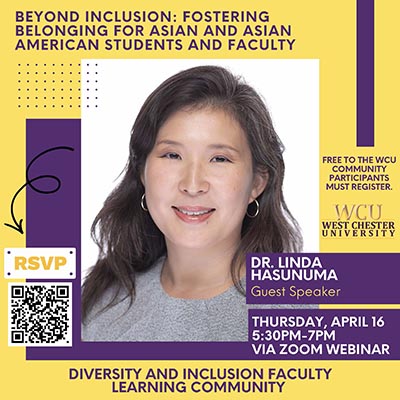
Inclusion Presentation: Fostering Belonging for Asian and Asian American Students and Faculty
Join us for a presentation by Dr. Hasunuma on fostering belonging for Asian and Asian American students and faculty.
Date: Thursday, April 16, 5:30 PM - 7:00 PM
Location: Zoom
The event is free to the WCU community, registration is required.
Attend the Celebration of Teaching
Join your colleagues at any or all of the four events on Thursday, May 7 celebrating the incredible teaching happening every day across WCU! Sample and discover new WCU teaching innovations, dialog with peers on teaching topics, and celebrate the teaching excellence that happens at WCU. The day’s events include:
- 4 mini-workshops
- The 11th Teaching Excellence Showcase
- A virtual keynote presentation with Eileen Kogl Camfield, editor of “Joy-Centered Pedagogy in Higher Education”
- TLC Golden Rammy Teaching Awards Ceremony
Learn more or register to attend any of the four events.
We still have some slots left in the Teaching Excellence Showcase. If you are interested
in presenting submit an application by Sunday, April 12.
Applying the Quality Matters Rubric (APPQMR) Workshop
The Applying the Quality Matters Rubric (APPQMR) workshop is facilitated by TLC staff and introduces you to the principles of the Quality Matters (QM) program. You learn how to draft a QM recommendation and practice applying the QM rubric to an actual course. Completing the full day workshop is a requirement for participating in the Quality Matters Initiative and it renews your WCU CAPC Distance Education statement.
Date: Friday, May 15, 8:30 AM - 4:00 PM
Location: Anderson 125
The training will be in person; participants must attend the whole day. Lunch will be served. Complete the APPQMR Interest Form, and a member of the TLC will be in contact a few weeks prior to the workshop with official registration information. Space is limited.
Summer Teaching Circle: Balancing AI Use in Teaching Lesson Plan Creation
A teaching circle is a group of faculty who collectively explore a teaching topic of interest and work together to create products reflecting their learning experience. This summer 2026 teaching circle will explore questions around the extent to which AI use should be encouraged or incorporated in teaching lesson plan creation to pre-service teachers. This topic is specifically targeted to College of Education and Social Work faculty; however, any faculty interested in the question of balancing AI use in teaching are welcome to join this circle. Past Teaching Circle participants may sign up again.
Dates: Wednesdays in June, 1:00 PM - 2:00 PM
Location: Zoom
For more information visit the Teaching Circle website. Please register here.
Program Updates
SoTL Spotlight: AI Virtual Reality and Simulations
Congratulations to the following authors for their recent SoTL publications which we highlighted via our SoTL Spotlight. If you are interested in the TLC promoting your scholarship of teaching and learning publication, email the TLC.
Dr. Nancy Barker, Dr. Danielle Yocom, and Dr. Michelle DaSilva from nursing recently published Measuring undergraduate nursing students’ acceptance of AI enabled virtual reality using AI generated simulations in the Teaching and Learning in Nursing Journal.
Dr. Brittany Severino had two publications. How Are You? Increasing Pre-Service Educators’ Out-of-Class Communication with Social and Emotional Learning in the International Journal for the Scholarship of Teaching & Learning and Social and Emotional Learning in Higher Education: Professors Supporting Mental Health Concerns in the Journal of Effective Teaching in Higher Education with co-author Emma Oswald.
Teaching Hub Spotlight
We are pleased to share a recent addition to the TLC Teaching Hub: Dr. Jaeyong Choi’s Structured, Stage‑Specific Guidance for AI‑Supported Writing in Class , which offers a practice‑informed approach to using AI to support student writing.
Do you have a teaching strategy, reflection, tool, methodology, or SoTL work you would like to share with WCU colleagues? The TLC welcomes contributions and repurposed resources. To have your work featured, contact tlc@wcupa.edu.
Faculty Mentoring Program Updates
Monthly Discussion: Service
Service can be rewarding and challenging. We encourage you to engage in meaningful conversation this month. Consider how your service interests and goals align with your teaching and scholarship, and whether service offers opportunities to expand your network. Because service comprises 15% of pre-tenure responsibilities, reflect on whether your current commitments feel “just right,” too much, or if you have space to take on work aligned with your interests. Past participants note that setting clear goals helps with knowing when to say yes or no. We also recommend an NCFDD article, "It’s Crunch Time" (reminder, WCU is an institutional member to NCFDD).
Stay Connected
Connect With Us
The Teaching and Learning Center is far more than just a newsletter! Our website hosts a variety of teaching resources and our full Event Calendar. To get in touch, feel free to send us an email, or schedule a consultation to speak live with one of our designers.