
Email Etiquette Policy
One common reason for a dispositions conversation is email etiquette. Since university professors and staff use email to communicate with students, it is imperative that you learn to communicate professionally in your email.
What is email etiquette?
- It is a ‘Code of Conduct’ for email communications. It refers to the principles of behavior that individuals should use when writing and responding to emails.
Why is email etiquette important?
- The way you craft an email is a direct reflection of you and our field. It’s important to learn to communicate in a clear, respectful, and professional manner, especially since you will be emailing parents, administrators, and students.
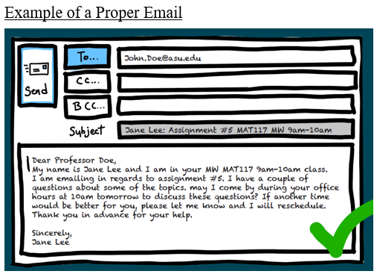
Strike the right tone:
- Use email for everyday communications. Save personal or important issues for face-to-face conversations.
- Use complete sentences and proper punctuation.
- Be succinct and keep your message short and to the point.
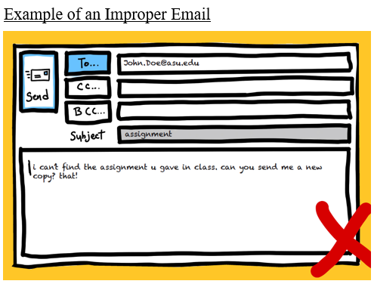
- Avoid informal language more common with friends such as “what’s up” “things” or “peace out.”
- Be respectful and avoid emailing when emotionally charged or using all caps.
- Do not use emoticons, excessive punctuation (!?!?!?) or acronyms (LOL).
Formatting:
- The subject should be short and simple but not vague.
- Begin new emails with a salutation (greeting) such as “Hello Professor _______”. Subsequent emails on the same topic do not require a salutation.
- Conclude the email with a closing that matches the tone of the email, “Thank you” or “Sincerely.” An alternative
- is to setup a standard signature (name, contact information) to conclude an email.
- Somewhere in the email, include your full name and the class number or title.
- Always proofread emails. An occasional error is normal, an email replete with errors is unprofessional.
Other Tips:
- Allow 48 weekday hours before following up on an email for which you have not received a reply. This excludes weekends.
- Respond to emails from a professor in a timely manner, again within 48 hours.
- Only “cc” (carbon copy) individuals directly involved in the conversation.
- To protect your privacy, only use your WCU email to communicate with anyone on campus.