
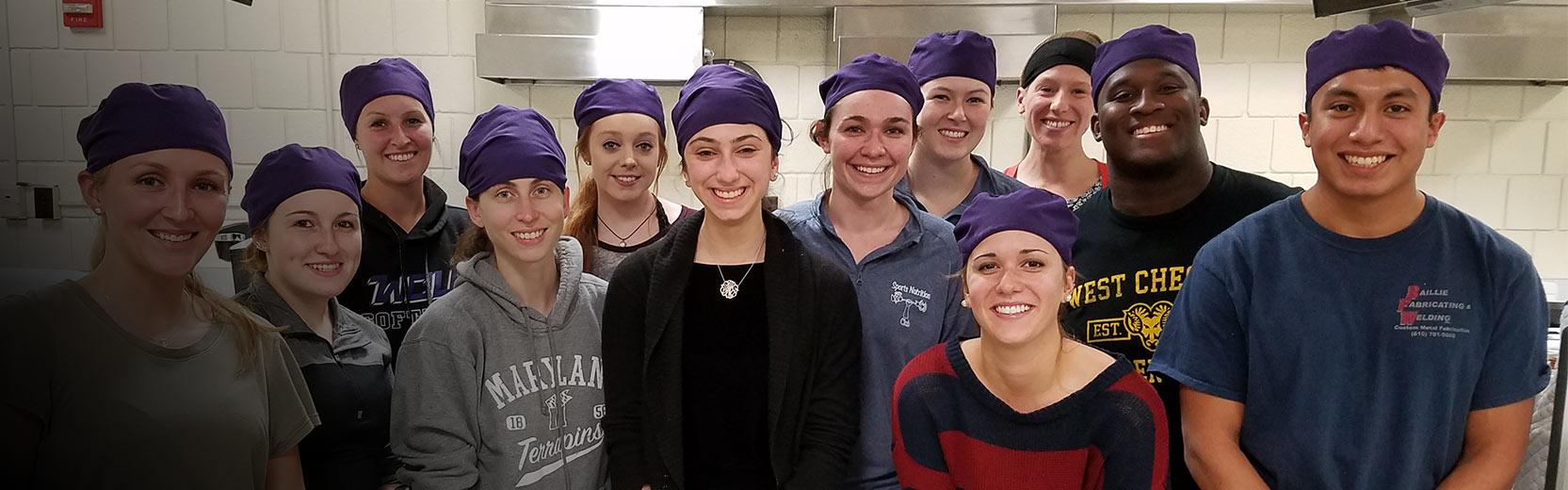

Nourish Your Passion and Build a Career in Nutrition
Food fuels our bodies and minds and affects our overall health and well-being. If you'd like to make a real difference in the world, the nutrition major at West Chester University is a great place to start. You'll impact communities by promoting healthy lifestyles and disease prevention to help people live longer, happier lives.
WCU's Nutrition program will train you as an expert in food science, micro- and macronutrients, nutrition management, and more, including interdisciplinary courses in psychology and exercise physiology.
In our Nutrition degree, you can pursue your passion while gaining the knowledge and skills for a variety of careers in the nutrition and healthcare industries.
Tracks in the Nutrition Degree Program
Dietetics
WCU's ACEND-accredited dietetics concentration is the perfect springboard for a successful career as a Registered Dietitian (RD/RDN). Our rigorous coursework and internship requirement will prepare you for the challenges and rewards of graduate school and the RD/RDN credential.
In addition to your coursework, you'll complete a supervised internship program to gain real-world experience working with clients and developing your skills as a practitioner.
Upon graduation, you'll be eligible to take the RD/RDN exam, which will allow you to practice dietetics in a variety of settings.
Benefits of Earning Your Nutrition Degree at West Chester University
Accreditation and Reputation for Quality
Our Nutrition degree in dietetics is accredited by the Accreditation Council for Education in Nutrition and Dietetics (ACEND). The rigorous accreditation process means our program meets the highest standards for quality. It also means that WCU graduates are eligible to take the RD/RDN exam, are well prepared for a future career in nutrition, and will stand out in the job market.
Clubs and Organizations for Nutrition Majors
We offer plenty of ways for you to get involved and connect with students who share the same passion for nutrition, including:
- College Diabetes Awareness Club
- Foodservice System Management Club
- Phi Epsilon Kappa Honor Society Fraternity for Health Science Majors
- Ram Chefs
- Student Dietetic Association
- WCU Sports Nutrition Education and Fueling Program
Accelerated B.S. in Nutrition Dietetics to M.S. in Community Nutrition
If your plans include becoming a registered dietitian (RD/RDN), you may be interested in our accelerate degree program. To be RDN eligible, you must have a master’s degree. Through this accelerated program, you can earn both your Bachelor of Science in Nutrition Dietetics and your Master of Science in Community Nutrition in just five years, rather than six. Upon graduation, you will be eligible to sit for the registration examination for dietitians to earn your RD/RDN credentials.
What Can You Do With a Nutrition Degree?
According to the U.S. Bureau of Labor Statistics, jobs for dieticians and nutritionists are expected to increase by 7 percent through 2032. There are many roles available within the field of nutrition, with a variety of salary ranges based on industry, education, and experience. Health education specialists, for example, earned an average of $59,990 in 2022. Nutritionists and dietitians earned an average of $66,450 in the same period.
Our Nutrition degree graduates can be found working in a variety of roles and fields, including:
- Health coach
- Nutrition educator
- Nutrition/wellness coach
- Weight loss counselor
- Health program coordinator
- Foodservice director
- Certified dietary manager
- Medical nutrition therapy
- Sports nutrition
- Corporate wellness
- Private practice
- Research
Additionally, many of our dietetics graduates have pursued other career pathways and professional schools after graduation, including medical school, nursing school, physician assistant school, and physical therapy school, to name a few.
What Will You Study as a Nutrition Major?
Regardless of your concentration, as a nutrition major you will learn how to improve the health and well-being of populations through food.
B.S. in Nutrition - Dietetics Concentration
| Code | Title | Credits |
|---|---|---|
| GENERAL EDUCATION REQUIREMENTS 1 | ||
| Academic Foundations | ||
| First Year Experience requirement | 4 | |
| English Composition requirement | 6-7 | |
| Mathematics requirement | 3-4 | |
MAT 121 | Introduction to Statistics I | |
| Interdisciplinary requirement | 3 | |
| Diverse Communities requirement | 3 | |
NTD 200 | Nutrition and Culture | |
| Ethics requirement | 3 | |
| Distributed Disciplinary Foundations | ||
| Science requirement | 6-8 | |
BIO 100 | Basic Biological Science | |
or BIO 110 | General Biology I | |
CHE 107 | General Chemistry for Allied Health Sciences | |
| Behavioral & Social Science requirement | 6 | |
PSY 100 | Introduction to Psychology | |
SOC 100 | Introduction to Sociology | |
| Humanities requirement | 6 | |
| Arts requirement | 3 | |
| ADDITIONAL BACCALAUREATE REQUIREMENTS 1 | ||
| University Requirements | ||
| Writing Emphasis requirement | 9 | |
| Speaking Emphasis requirement | 9 | |
| Degree Requirements | ||
| Capstone requirement | 1-15 | |
| MAJOR REQUIREMENTS | ||
| Common Major NTD Required Courses 2 | ||
| NTD 200 | Nutrition and Culture 3 | 3 |
| NTD 205 | Principles of Food Selection and Preparation | 3 |
| NTD 303 | Introductory Principles Human Nutrition | 3 |
| NTD 309 | Nutrition Throughout the Lifecycle | 3 |
| NTD 310 | Nutrition Research | 3 |
| NTD 410 | Quantity Food Production | 3 |
| NTD 415 | Community Nutrition | 3 |
| NTD 416 | Food Service and Nutrition Systems Management | 3 |
| Common Cognate Requirements 2 | ||
| MAT 121 | Introduction to Statistics I 3 | 3 |
| BIO 100 | Basic Biological Science 3 | 3 |
| or BIO 110 | General Biology I | |
| BIO 269 | Human Anatomy and Physiology II | 4 |
| BIO 259 | Human Anatomy and Physiology I | 4 |
| CHE 107 | General Chemistry for Allied Health Sciences 3 | 4 |
| CRL 107 | General Chemistry Lab for Allied Health Sciences | 1 |
| PSY 100 | Introduction to Psychology 3 | 3 |
| SOC 100 | Introduction to Sociology 3 | 3 |
| Dietetics Concentration Required Courses 2 | ||
| NTD 314 | The Dietetic Profession | 3 |
| NTD 320 | Strategies in Dietetics Education | 3 |
| NTD 370 | Nutrient Metabolism | 3 |
| NTD 381 | Micronutrients | 3 |
| NTD 400 | Clinical Nutrition Assessment | 3 |
| NTD 408 | Food Science | 3 |
| NTD 411 | Macronutrients | 3 |
| NTD 413 | Medical Nutrition Therapy I | 3 |
| NTD 414 | Medical Nutrition Therapy II | 3 |
| Dietetics Concentration Cognate Courses 2 | ||
| BIO 204 | Introductory Microbiology 2 | 4 |
| Electives | ||
| Students must take the required courses in their concentration to reach the 120 credits required for graduation. | ||
| Capstone Requirement | ||
| NTD 409 | Nutrition Communication and Counseling 1,4 | 3 |
| Total Minimum Credits Required | 120 | |
Accelerated B.S. in Nutrition - Dietetics Concentration to M.S. in Community Nutrition - Dietetic Internship Track Program
To be considered for the accelerated program, students must have attained (completed) 72 credits and have a minimum cumulative GPA of 3.5. Students in the accelerated program can substitute up to 12 credits of graduate coursework for electives that satisfy the B.S. program requirements.
The following M.S. courses will be the accelerated students’ elective courses. The 12 credits in the fall spring semesters of Year 4 are counted as the elective requirements for the B.S. and required courses for the M.S.
| Code | Title | Credits |
|---|---|---|
| Electives 5 | ||
| Choose from the following: | 12 | |
NTD 503 | Human Nutrition | |
NTD 515 | Public Health Nutrition | |
NTD 600 | Maternal & Child Nutrition | |
NTD 612 | Nutrition and Human Behavior | |
Accelerated B.S. in Nutrition - Dietetics Concentration to M.S. in Community Nutrition Program
To be considered for the accelerated program, students must have attained (completed) 72 credits and have a minimum cumulative GPA of 3.2. Also, students must meet the minimum eligibility requirements for admission to the graduate program as specified by the graduate catalog and complete the accelerated graduate application. Students in the accelerated program can substitute up to 12 credits of graduate coursework for electives that satisfy the B.S. program requirements.
The following M.S. courses will be the accelerated students’ elective courses. The 12 credits in the fall spring semesters of Year 4 are counted as the elective requirements for the B.S. and required courses for the M.S
| Code | Title | Credits |
|---|---|---|
| Electives 5 | ||
| Choose from the following: | 12 | |
NTD 503 | Human Nutrition | |
NTD 515 | Public Health Nutrition | |
NTD 600 | Maternal & Child Nutrition | |
NTD 612 | Nutrition and Human Behavior | |
- 1
Courses selected under advisement. Note that many of the general education and additional baccalaureate courses will be fulfilled by the required cognates. Students are encouraged to schedule courses that fulfill both the interdisciplinary and writing emphasis requirements simultaneously or to schedule arts and/or humanities courses that simultaneously fulfill their writing emphasis requirement.
- 2
Students must complete all required NTD courses and MAT 121 with a minimum grade of C to graduate from the B.S. in Nutrition. The Dietetics concentration also requires a minimum grade of C for all science courses.
- 3
These required courses also satisfy general education requirements
- 4
This course fulfills the Capstone requirement.
- 5
These 12 elective graduate credits are to be taken during the senior year. Students will take these 12 credits at the graduate level and they will satisfy the requirements of the B.S. degree. These 12 credits are required courses in the both the 33 credit M.S. in Community Nutrition and the MSCN-DI programs.
Get Started on YourBachelor of Science in Nutrition
Take the next step on your journey to a rewarding career in nutrition. Start your application today.
Apply NowPrograms Related to Nutrition Major
