
Preparing for internships
General Preparation Info
Internship Preparation by Year
Make a copy of this spreadsheet to begin tracking your experiences.
Freshman Year - Exploring Possibilities
Key Goal: Clarify your interests and research career paths.
- Try a WCU club or a major-related organization to connect with upperclassmen and the
campus community.
- Resource: WCU Clubs and Organizations
- Connect with academic advisors and professors to get advice on your college career.
- Resource: WCU Business Faculty Directory
- Visit the Career Development Center to know their staff, programs, and resources.
- Resource: Career Development Center
- Identify what academic strategies work best for you to improve your academics.
- Research career pathways that interest you to begin making post-grad plans and begin
to move towards completing them.
- Resources: FOCUS Interest Quiz, Occupational Outlook Handbook, O*Net Online
- Start to prepare your resume, LinkedIn profile, and Handshake profile to prepare for
networking and the job search process.
- Resources: Resume Review Tool; Resumes, CVs, and Cover Letters (on this page)
- Take a professional headshot at the Career Center Photo Booth to use for your LinkedIn.
- Resource: Iris Photo Booth
- Get an on-campus job to gain job skills that are transferable to an internship.
- Resource: WCU uses Handshake for all on-campus jobs.
- Learn about where other students interned and see what companies you might want to
work for.
- Research and participate in freshman and sophomore internship programs, sign up for
employer virtual events, newsletters, job opening alerts, and set up Handshake alerts
to track updates.
- Resources: Top Internship Employers to Watch (on this page), Handshake
- Take time to intentionally reflect on your interests and experiences to have a more refined definition of career directions and what you are looking for in an internship.
Sophomore Year - Building Skills & Making Connections
Key Goal: Cultivate meaningful professional connections and build your career aspirations.
- Select a business major, minor, or concentration to specify your career direction
and guide your future internship and job search.
- Resource: WCU Business & Public Management Majors
- Schedule an appointment with the career advisors to review your resume and get suggestions
to build relevant experience and skills for your desired path.
- Resources: Use Handshake to schedule meetings with career advisors.
- Attend the Job & Internship Fair, Meet the Firm, Information Sessions, or other employer
events to network and learn about internships and job opportunities.
- Resource: Career Development Center Events
- Take at least 2 hours a week to learn the internship and job search process. Use the
high-quality resources curated in this guide to help you get started.
- Resource: Resources to Get You Started (on this page); LinkedIn Learning
- Identify WCU alumni in the career path you are interested in and reach out for information
interviews or job shadowing to get more insider views on the career.
- Resources: WCU Alumni Connection Dashboard, Ram Nation
- Continue to follow internship employers with early-career programs for sophomores,
and try to participate in the programs to understand the profession.
- Resources: Top Internship Employers to Watch (on this page)
- Learn how to network and seek mentoring opportunities in different ways to learn and
grow professionally.
- Resource: Networking & Mentoring
- Compile a list of companies in the industries you are interested in and start researching
their internship hiring cycles and alumni working in these companies.
- Resources: WCU Business Internship Opportunity Dashboard; Employer Hiring Cycle (on this page)
- Initiate your own research or join a faculty research project to grow your resume
and develop relevant career and research skills.
- Resource: Student Research Opportunity
- Get more involved in student organizations, expand your student networks, and take
on more responsibilities to grow your professional and leadership skills.
- Resource: WCU Clubs and Organizations
- Join a professional organization to gain visibility among employers, connect with
professionals in the organization, and seek professional mentors.
- Resource: Networking & Mentoring
- Explore summer internship opportunities to gain familiarity with the process. Do not
give up on an unpaid internship. Consider applying for the WCU Fund for Unpaid Internships.
- Resource: Internship Search Tools, WCU Fund for Unpaid Internships
- Consider applying your major-related skills to a part-time job or side work, and expand
your responsibilities to build a portfolio of your accomplishments and experiences
that enhances your resume and prepares you for interviews with recruiters.
- Resources: Resumes, CVs, and Cover Letters
Junior Year - Gaining Experience & Evaluating Your Future
Key Goal: Gain relevant career experience and reflect on your career direction.
- Meet with career advisors to discuss your career directions and the internship application
strategies, and talk through your challenges and concerns.
- Resource: Use Handshake to schedule meetings with career advisors.
- Begin strategically applying for internships to secure relevant work experience aligned
with your career goals.
- Resource: Internship Search Tools (on this page)
- Monitor employer hiring cycles for internship and entry-level jobs, and start documenting
your application process. Set up job alerts to gain an understanding of the job market
in the career path and industries that you are interested in.
- Resource: Employer Hiring Cycles (on this page)
- Update and tailor your resume and cover letter to specific job ads and roles. Use
the resources in this guide to enhance your resume and cover letter writing skills.
- Resource: Resumes, CVs, and Cover Letters (on this page)
- Connect with alumni at your interested employers to gain insight into the workplace
and learn about internship and post-graduation opportunities in their organizations.
- Resource: Alumni Connection Dashboard
- Seek referrals from mentors to improve your chances of being considered for hidden
internship opportunities.
- Resource: Networking & Mentoring
- Prepare for interviews, research the company and internship position, and build your
confidence and increase your chances of being hired.
- Resources: Interviewing (on this page), BigInterview
- Use the internship opportunity to evaluate your strengths and grow your professional
skills, and seek to secure a full-time job offer.
- Resource: From Internship to Full-time Job (on this page)
- Share your internship experiences and become an internship mentor to cultivate your
leadership skills and help other students grow.
- Resources: Share your Internship Experience
Senior Year - Securing a Job Post-Graduation
Key Goal: Make decisions and seek out long-term, full-time career opportunities.
- Evaluate your internship and other professional experiences during college years and further clarify your career directions, and get prepared for applying for full-time jobs.
- If the internship aligns with your career goals, seek full-time job opportunities with your internship employer, either in your current role or in a more desired role.
- Evaluate your internship experiences to understand where you excel or lack in professional experience. Seek deliberate practice to improve your skills.
- Build a portfolio for career-related artifacts, experience, and achievement. Tailor your resume, cover letter, and interview for each targeted organization and position.
- Connect with your mentors, alumni, and other professionals in the networks and inform them of your career directions and intention to seek a full-time job.
- Continue to monitor and apply for desired job opportunities and track the application process. Reflect on the progress and gaps.
- Frequently assess application results and refine your job search strategies. Continue to improve your resume and interview skills. Revisit resources in this guide for new ideas, insights, and renewed momentum.
- Reach out to seek advice and emotional support from your career advisors, mentors, alumni, family, and friends. Remember, in this journey, you are not alone.
- Reflect on your job-seeking experience, strategies, and career directions, and improve your career decision-making.
Listen to Others — Preparing for Internships:
Resources to Get You Started
- Turning an Internship into a Job (2016) [Course | 54 min]
- This LinkedIn Learning course guides you through the process of considering an internship, finding opportunities, increasing your value, and turning an internship into a full-time job opportunity.
- Turning an Internship into a Job (2020) [Course | 30 min]
- This LinkedIn Learning course guides you through the process of finding the right internship, landing the internship, making yourself irreplaceable, and using your internship to get a full-time job.
- Managing Your Job Seeker Mindset [Course | 31 min]
- This LinkedIn Learning Course covers effective strategies for developing and sustaining the proper mental state to propel you forward as you seek your next position. They show you how to create your best physical and mental space, calm your body, ask questions with confidence, and build resilience and bounce back from missteps.
- Job Search Strategies [Course | 37 min]
- This LinkedIn Learning course teaches you how to develop your profile and brand, seek advertised and unadvertised positions, network successfully to broaden your circle, and work with recruiting professionals.
- A Career Strategist's Guide to Getting a Job [Course | 49 min]
- This LinkedIn Course explores strategies designed to increase the chances of hearing back from potential employers, including how to get a resume past applicant tracking systems (ATS).
- Find a Job in the Hidden Job Market [Course | 37 min ]
- 80% of jobs are not posted on job boards or company websites. These positions are filled in the hidden job market. In this course, you can learn how to access these unadvertised jobs by targeting your search, changing how and where you network, and taking action to supercharge your job hunt.
- Making Recruiters Come to You [Course | 37 min]
- This course helps you master using LinkedIn, understand the role of your resume and cover letters in the job search process, and uncover the best ways to connect and follow up with a recruiter.
- Finding a Job on LinkedIn [Tutorial | 51 min]
- Explore strategic ways to use LinkedIn to elevate your job search process and connect with the right people to find the career opportunities you want.
- Harvard Business Review Job Hunt [YouTube Playlist]
- Including topics on cover letter, resume, and interview.
- Indeed Job Search Academy Workshop [Recording]
- Including topics on career management, career strategy, resume, interview, negotiation, job search, and AI advantages.
- IHire Job Seeker Resource Library Webinar Series [Recording]
- Including a wide range of topics on career planning, job search, cover letter, resume, etc.
- Get Hired with Andrew Seaman [Podcast]
- Over 200+ episodes on job search, resume, cover letter, interview, and getting hired.
- Advertising Educational Foundation MADE Online Workshop Series [Recording]
- Expert-led sessions covering key topics in career development. These workshops feature industry leaders sharing insights on: Career Readiness & Personal Branding – Resume tips, interview strategies, and how to stand out in the job market. Networking & Leadership Development – Building meaningful connections and strengthening your leadership skills.
- CBE Careers in Economics Webinar Series Recording [Webinars]
- Find out the types of problems economists solve at these companies, the tools, skills, and knowledge you need to get hired and get promoted as an economist in the various sectors, and the career paths of our speakers.
- The Internship Show [Podcast]
- A podcast that interviews individuals about internship experiences and internship hiring, with a focus on business.
- Making Waves Education Foundation Resource Library [Guide]
- Guidance on the internship search process covering personal branding, professional development tips, job search resources, and more.
- UPenn Resource Library [Portal]
- Resources for all steps of the internship application process, from help on discovering your interests to resume, interview, and negotiation.
- ChatGPT Prompts for Jobseekers [Course | 1 hour 13 min]
- LinkedIn Learning course addressing topics on using AI for job hunting, as a career coach, and for writing a resume, cover letter, and improving a LinkedIn Profile.
Employers' Hiring Cycles
Depending on what industry you want to work in, you may find that certain times of the year are easier to find jobs than other times. Each industry has a hiring cycle, in which they only recruit for new positions during some times.
Top Internship Employers to Watch
Top Accounting or Consulting Internship Employers
- Accenture — Elevate to Innovate Externship (Freshmen), Accenture Innovation Challenge & Student Leadership Program (Sophomores), Summer Analyst Program (Junior), Internship | Current Openings
- Andersen — Aspire Program (Freshmen); Accelerate Program (Sophomores & Juniors), Ambassador Program, Internship, Associate (Entry-level) | Current Openings
- Aprio — HeadStart Program (Freshmen & Sophomores); Internship | Current Openings
- BDO USA — Pathway to Success Program (Freshmen & Sophomores); Internship | Current Openings
- CBIZ — CBIZ Career Compass Webinar Series (Any Level), Internship | Current Openings | Register for Events
- Deloitte — Competition, Leadership Program, Discovery Internship (Freshmen & Sophomores), Internal Service Internship, or Client Service Internship | Current Openings
- EY LLP — Expedition EY (Freshmen & Sophomores) CHARGE (Sophomores+)| Service Line Internships | Current Openings | Register for Virtual Event
- Grant Thornton LLP — Growth Program (Freshmen & Sophomores), Internship | Current Openings
- KPMG LLP — Pre-Internship Programs (Freshmen+), Internship | Current Openings
- Moss Adams — Ignite Scholarship (Freshmen & Sophomores); Guide Pilot Steer Operational Internships (Sophomores & Juniors); Internships | Current Openings
- PricewaterhouseCoopers LLP — Advance Internship | Current Openings
- Protiviti Inc.— Discover (2-year before graduation) | Internship (6-12 months out from graduation) | Current Openings
- RSM US LLP — RSM Excellence Academy (3 years from graduation), Pathways (2 years from graduation), Internship, and scholarship | Current Openings
Top WCU Business Internship Employers
- Cencora [Healthcare Supply Chain] Internship, Co-Op Program | Current Openings
- Clark Associates [Food Service Equipment] Internship | Current Openings
- Comcast [Telecommunication] Internship | Current Openings
- Enterprise Mobility [Transportation] Management, Accounting, IT Internships | Current Openings
- Esri [Mapping and Analytics Software] Summer Internship Program, Student Assistantship Program | Current Openings
- GSK [Biopharmaceutical] Internship and Co-Ops | Current Openings
- Hershey [Confectionery Manufacturing] Internships and Co-Ops | Current Openings
- Johnson & Johnson [Pharmaceuticals & MedTech] Internships, Co-Ops | Current Openings
- JP Morgan Chase [Financial Services] Pre-Internship (Freshmen+), Internship | Career Events | Current Openings
- Lincoln Financial [Financial Services] Internship Development Program (Recruiting Period September - December), Actuarial Internship Development Program (Recruiting Period September - December) | Current Openings
- Merck [Pharmaceutical] Internships & Co-ops Future Talent Program | Current Openings
- Saint-Gobain [Construction Materials] Internship & Co-Ops | Current Openings
- SAP [Enterprise Software] SAP Student Training and Rotation (STAR), Internships | Current Openings
- SEI [Financial Technology] Summer Internship Program [Application starts in early January]
- Siemens Healthineers [Medical Technology] Internships, Leadership development & Rotational Programs| Current Openings
- UnitedHealth Group [Healthcare] Sales Program, Corporate and Business Operations Program | Current Openings
- United States Liability Insurance Company (USLI) [Insurance] College Student Program [Application starts in March]
- Vanguard [Financial Services] College to Corporate (C2C) Internship Program, Data Scientist Internship Program [Application Starts in August] | Current Openings
- Wells Fargo [Financial Services] Undergraduate Programs| Career Events | Current Openings
Internship Search Tools
WCU Internship Search Tools
Handshake - WCU career platform that connects you with internships and job opportunities
Business Student Internship Map - See where other WCU business students have completed internships in Chester County and surrounding areas. Use the internship/job site link to explore opportunities from a specific employer.
Listen to Others — Internship Search
Top Internship Program Rankings
- Vault Top Internships
- Searchable resource for finding internship opportunities from top companies. Many summer-only internships are featured.
- Vault Companies with the best internship programs
- From Vault. Updated annually with the top 150 companies.
- Vault Top Internships by Industry
- From Vault. Top internship programs can be filtered by industry.
- U.S. News Best Companies to Work for Internships
- U.S. News list recognizes companies that offer exceptional internship experiences.
- National Intern Day Top 100 Internship Programs
- National Intern Day listing, updated annually on top internship programs.
- Employer with Dedicated Early Career Programs for Young Talent
- A list of 1,000+ organizations to consider if you're looking for early career programs, internships, analyst programs, rotational programs, or leadership development programs. Not all companies on the list are currently hiring.
Internship Search Tools for College Students
- Prosple Internships
- Jobs, internships, experiences & programs for students and fresh graduates.
- Wayup Internships by Category
- Entry-level and internship jobs by category. Find opportunities for accounting, business, marketing, supply chain management, etc.
- Intern-List
- Hourly updates from LinkedIn, Indeed, Handshake, and 200K+ career sites for internship opportunities.
- CampusPhilly
- Search tool for jobs & internships in the greater Philadelphia area for college students and recent graduates.
- College Grad
- Search tool for internships and entry-level jobs. Also has job search advice.
General Job and Internship Search Tools
- LinkedIn Internship Search
- Job search interface. Search for intern or internship in the jobs category. Or use the [employment type: internship] to identify internships in nearby locations.
- Indeed Internship Search
- Job search interface. Limit the [job type: internship] to find regional internship opportunities.
- Google Internship Search
- Google job search interface. Limit the [job type: internship] to find regional internship opportunities.
- National Labor Exchange Jobs
- CareerOneStop job boards via National Labor Exchange. Search for a specific intern role, such as “HR intern,” to find related opportunities.
- Simplify
- Personalized internship and general job search tool. Also offers resume help and job application organization
- Diversity Jobs
- Diversity recruiting platform. Search [job type: Intern] to find internship opportunities.
PA-Specific Internship Search Tools
- Pennsylvania CareerLink
- State hiring job boards. Search [job type: internship] and view by date posted.
- Internships with the Commonwealth
- Official Pennsylvania State Government page for college internships. Internships are available across multiple sectors.
- The Greatest Places to Intern in PA Awards
- The 2025 awardee list for the companies awarded the greatest places to intern in PA by the PA Chamber Foundation.
- CampusPhilly
- Search tool for jobs & internships in the greater Philadelphia area for college students and recent graduates.
Nonprofit and Government Internship Search Tools
- Internships with the Pennsylvania State Government
- Official Pennsylvania State Government page for college internships. Internships are available across multiple sectors.
- Federal Internship Finder
- Search tool for internships and some entry-level jobs for the federal government. Opportunities are available across all 50 states and abroad.
- Federal Reserve System Intern
- Federal Reserve Bank career system job list. Search with the keyword "intern".
Internship Search Tools by Major
* Many internships or jobs are open to students in multiple majors. Besides the following specialized internship search tools, try the general search tools, or browse the top internship programs.
Accounting
- Vault Best Accounting Internships
- Vault internship ranking by industry category - accounting.
- Wayup Accounting Internships
- WayUp internship search. Accounting category.
- ACCA Job Board Accounting Internship
- Association of Chartered Certified Accountants job board list with an option to filter accounting internship and entry-level jobs with global coverage.
- Intern-List Accounting and Finance Internship
- Daily update on accounting and finance internship opportunities.
See more at Accounting and Consulting Top Employers.
Economics & Finance
- Wayup Economics Internships
- WayUp internship search. Economics category.
- Vault Best Financial Services Internships
- Vault internship ranking by industry - financial services category.
- Vault Best Invest Bank Internships
- Vault internship ranking by industry - investment bank category.
- Adventis Internship Database
- Searching for 200+ firms’ internship opportunities in investment banking, private equity, etc.
- ACCA Job Board Financial Planning & Analyst Internship
- Association of Chartered Certified Accountants job board list with an option to filter financial planning & analyst internship and entry-level jobs with global coverage.
- E-financial Careers Internship and Graduate Trainee
- Financial career jobs in the global market. Use the [position type: internship] to find financial career opportunities for internships.
- Wayup Finance Internship Job Lists
- WayUp internship search. Finance category.
- Certified Financial Planner Job Board
- Certified financial planner job search. Filter the job opportunities by level - internship.
- Vault Best Insurance Internship
- Vault internship ranking by industry - insurance category.
Marketing & Sales
- American Marketing Association Job Board
- American Marketing Association Job - Internship opportunities.
- Public Relations Society of America Internship List
- Internship job list in public relations, media, and communications.
- WayUp Marketing Internship Job Lists
- WayUp internship opportunities in the Marketing category.
- Advertising Educational Foundation MADE Internship Program
- The MADE (Marketing & Advertising Education) Program places students in paid summer internships at top companies.
- American Advertising Federation Internship Program
- The Campus-to-Corporate Talent Internship program connects current AAF College Chapter Members with their organization partners.
- American Advertising Federation Internship List
- Internship opportunities from the American Advertising Federation job board. Search “Intern” to find the opportunities.
- WayUp Sales Internship Job Lists
- WayUp internship opportunities in the Sales category.
General Management
- Retail Industry Signature Internships
- NRF Foundation internship and jobs.
- Vault Best Retail Internships
- Vault internship ranking by industry - retail category.
- Vault Consumer & Industrial Products Internships
- Vault internship ranking by industry - consumer & industrial products category.
- WayUp Management Internship List
- WayUp internship opportunities in the Management category.
Human Resources
- WayUp Human Resources Internship
- WayUp job search interface in the human resources category.
- IHire HR Internship List
- IHire human resources job list. Select all job titles and select [employment type: internship]
- Society for Human Resource Management (SHRM) Job Board Internships
- SHRM job board with the internship tab at the top.
- Association for Talent Development Job Board Internship
- Association for Talent Development job list. Search intern to find internship opportunities.
Supply Chain Management
- WayUp Supply Chain Management Internships
- WayUp job search interface in the supply chain category.
- Vault Best Travel & Transportation Internships
- Vault internship ranking by industry - travel & transportation category.
- IHire Logistics Internships
- IHire logistics job list. Select all job titles and select [employment type: internship].
- JobsInLogistics Internship Jobs
- Logistics-focused job sites and employers may post internship opportunities as well.
- LogisticsJosWeb
- Logistics-focused job sites. Search intern to find internship opportunities.
Project or Product Management
- Product Development and Management Association (PDMA) Career Center
- Search for intern opportunities in production development areas.
- Project Management Institute [PMI] Job Board
- Search for intern opportunities in project management areas.
- Institute Project Management Job Board
- Search for intern opportunities in project management areas.
Business Analytics
- ACCA Job Board Business Analyst Internship
- Association of Chartered Certified Accountants job board list with an option to filter business analyst internship and entry-level jobs with global coverage.
- Wayup Business Interns
- WayUp job search interface in the business/business analyst category.
Startups
- Startup Internships
- Internship opportunity list in start-up companies.
- Built-In Startup Jobs
- Startup or tech company job opportunities. Search by experience level to find internships and entry-level jobs in startup companies. Change location to find jobs in other cities.
Avoid Internship or Job Scams
Does an offer sound too good to be true? Did you receive a message about a position you never applied for? Fraudulent job postings and recruitment scams are more common than you might think. Use the tips below to protect yourself and keep your job search on track.
Watch for these red flags:
- Poor writing quality. Legitimate employers proofread their communications. Typos, spelling mistakes, or awkward phrasing in an email are warning signs worth taking seriously.
- Suspicious sender address. Recruiters should contact you from a company domain (e.g., @companyname.com), not a personal account like Gmail, Hotmail, or Yahoo.
- Requests for personal or financial information. A legitimate employer will never ask for your Social Security Number, bank account details, or other sensitive information over email. Be cautious about sharing even basic identifying information — like your home address — with unknown contacts early in the process.
- Requests involving money or packages. Never respond to requests for check deposits, gift card purchases, wire transfers, or package pickups. These are hallmarks of common employment scams.
- Pressure to act fast. Be wary of recruiters who urge you to accept quickly or claim the opportunity will disappear if you don't respond immediately. Legitimate employers respect your time and decision-making process.
- No mention of taxes. A legitimate employer will ALWAYS ask you to fill out tax forms. It is advised to avoid participating in any employment where taxes are not withheld.
What legitimate employers will and won't do:
- They will ask for your bank account information — but only after you've accepted an offer, as part of standard payroll setup.
- They will always have you complete tax forms before your first paycheck.
- They will not contact you out of nowhere with a job offer, ask you to move unusually fast, or conduct the entire hiring process without a formal interview.
Do Your Research
Before engaging with any opportunity, take a few minutes to verify it. Search the
company online to see what others are saying. Look up the recruiter on LinkedIn and
confirm that their name, title, and company align with what was communicated to you.
Trust your instincts — if something feels off, it probably is.
A Note on Job Boards and Social Media
Scammers are increasingly sophisticated and know how to exploit popular job platforms and social networks. Approach unsolicited outreach on these channels with extra caution and always verify before engaging.
Read More: FTC Advice for Avoiding Job Scams
Resumes, CVs and Cover Letters
WCU Career Center Resource
The WCU Career Center has basic suggestions on how to compose your resume and cover letters. As a WCU student, you can also meet with Career Center staff to get your resume or cover letter reviewed individually.
Participate in Live Workshops
PA CareerLink Training Workshops
Register for the PA CareerLink event on resumes, cover letters, interviewing, job
searching, career coaching, and more.
Maine Line Chambers of Commerce Talent & Education Network Events
Register for the Talent & Education Network event throughout the year, organized by
the Maine Line Chamber of Commerce. Topics cover resume, interview, personal branding,
job search, and internship, and more.
Listen to Others — Applications, Resumes, & Cover Letters:
Resumes
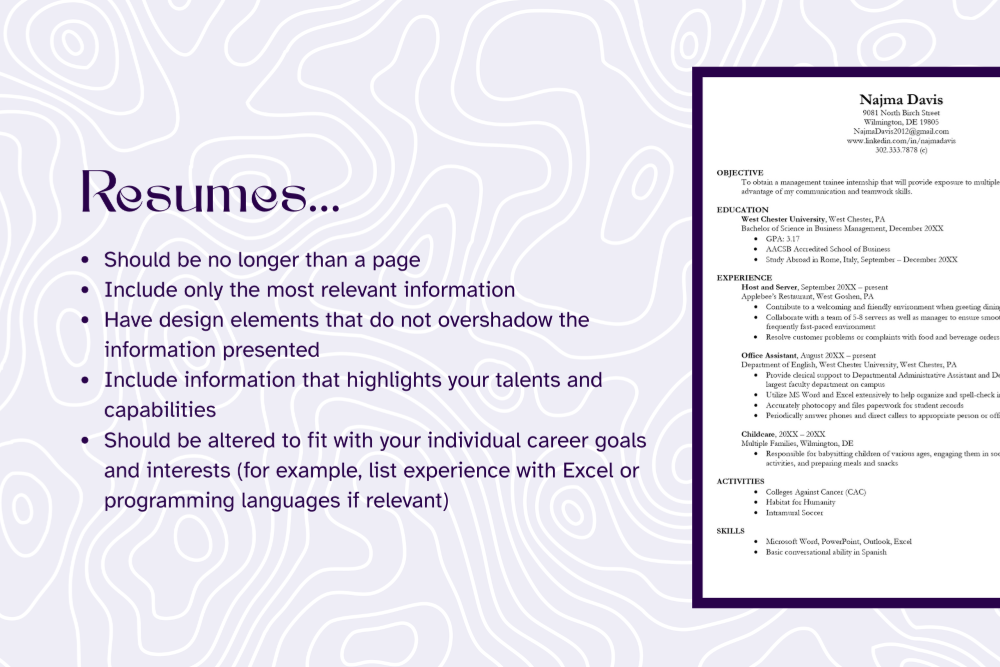
A resume will be submitted to nearly every job you apply to. A resume is a short, concise way to communicate to employers who you are. Unless you have extensive academic qualifications (like student research experience), resumes should focus on your past and present employment. Since resumes are concise and don’t provide much room for elaboration, be ready to talk about anything you list on your resume at interviews.
Links to Resume Resources
- How to Highlight Your Job Skills [Course | 56 min]
- In this LinkedIn Learning course, Career Coach Chris Taylor explores how to represent your job skills and background in a way that will highly resonate with prospective employers. He explores the areas of crafting a strong resume and cover letter, and building a positive online persona.
- Resume Rules for 2026 with Jenny Foss [Event Recording | 48 min]
- In this conversation with LinkedIn editor at large Andrew Seaman, career consultant and job search expert Jenny Foss shares what it takes to get your resume seen and read.
- What You Need to Know About Crafting a Stand-out Resume [Podcast | 14 min]
- In an episode of the LinkedIn podcast Get Hired, Ana Lokotkova, a seasoned resume writer and career advisor, shares insights and practical strategies to help you stand out from the competition.
- Expert Resume Tips | Career Talks by LinkedIn [YouTube Playlist]
- Tips on how to write an effective resume, sections, and writing a resume with limited experience.
- Writing a Resume [Course | 2.5 hours]
- LinkedIn Learning course on detailed steps and sections for writing a successful resume with Stacey Gordon, Founder and CEO of Rework Work.
- Resume Makeover [Course | 1 hour]
- LinkedIn Learning course on resume make-over and tailoring it to the roles you plan to apply to, getting the look and content right, and leveraging generative AI as a tool to build a stellar resume with Jenny Foss, Career Strategist, Speaker, Recruiter.
- The Elements of Resume Style [Ebook]
- The book covers essential rules for writing resumes and cover letters that work.
- Harvard Career Service - Create a Strong Resume [Guide]
- Resume tips, styles, samples, and AI strategies.
- UPenn Career Services Resume Samples [Template]
- Sample resumes for undergraduate students, including finance and consulting roles.
CVs
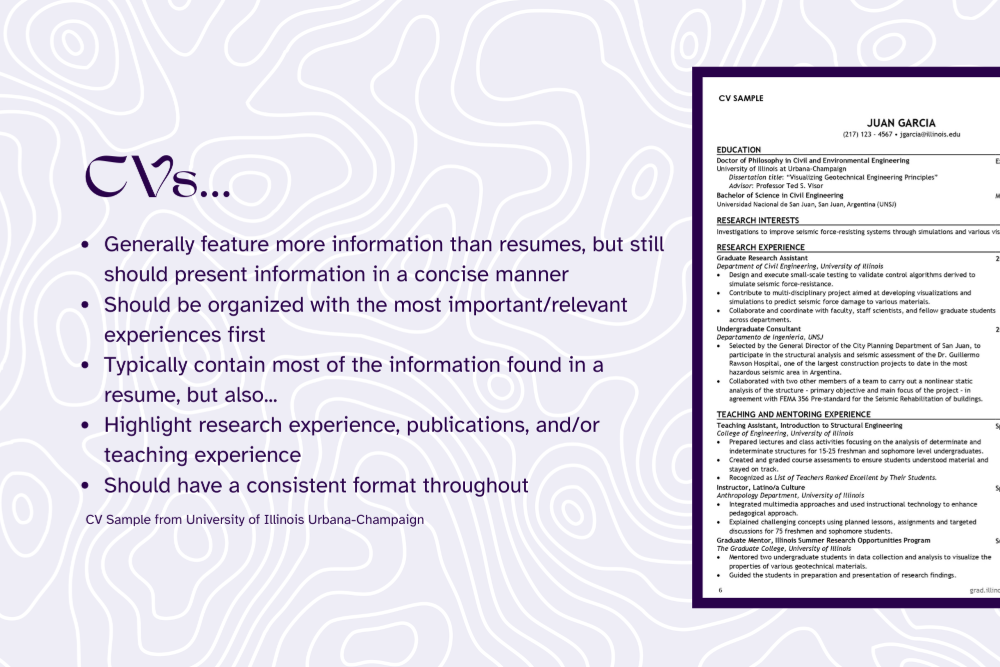
A curriculum vitae (CV) can be thought of as a longer, academically-focused resume. CVs typically are three or more pages, while resumes are advised to be only one page. While resumes mainly focus on employment and job skills, CVs are intended to highlight your academic strengths and experiences. Just like a resume, CVs should be updated as you gain knowledge and experience. You can use your resume to outline and develop your CV (or vice versa)!
Links to CV Resources
- CV Tips and Samples from the University of Illinois [Guide]
- 8-page guide on CV tips and CV samples.
- Resume and CV Tips from Cornell [Guide]
- Guidelines for preparing CVs, sample CVs, and resources.
Cover Letters
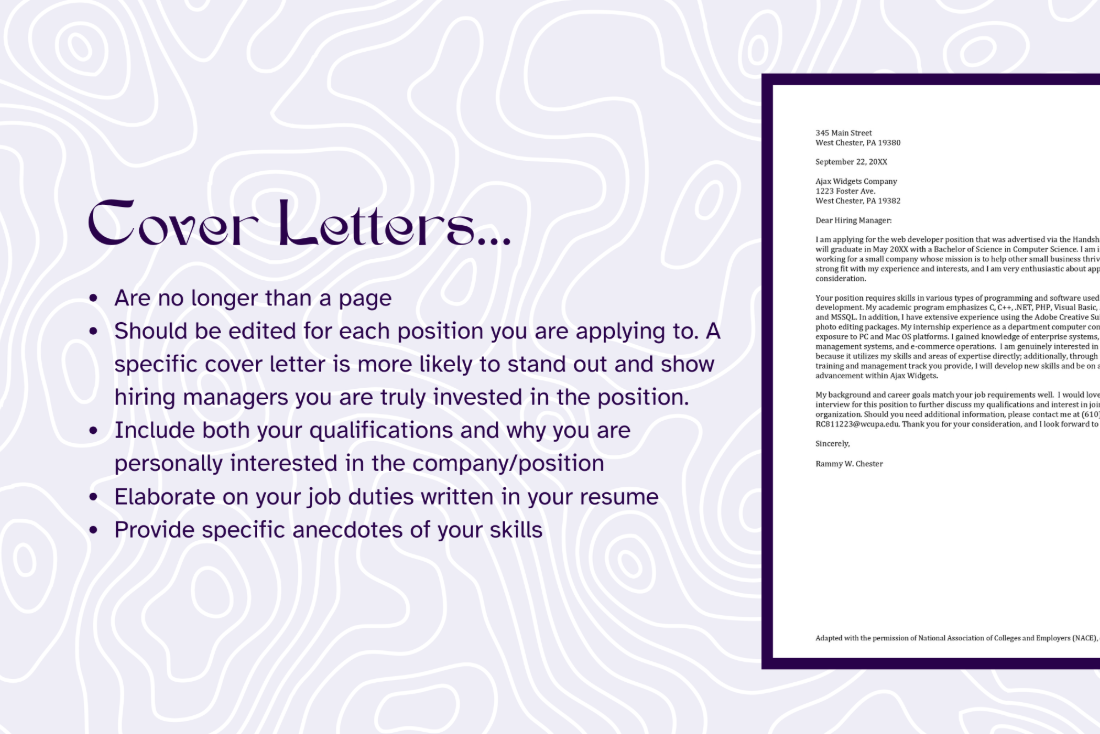
A cover letter is a three-to-four paragraph, one-page letter that is submitted with each job application. It highlights your interest in the particular position and expands upon the information provided in your resume. Cover letters can help clear up any questions potential employers may have after reading your resume. A cover letter is also a good place for you to find links between past jobs and explain how your skills developed over the course of your employment.
Links to Cover Letter Resources
- Writing a Cover Letter [Course | 20 min]
- LinkedIn Learning course on cover letters, detailing how to craft one from start to finish that helps you land the interview and the job with Jenny Foss, Career Strategist, Speaker, Recruiter.
- How to Write a Cover Letter that Sounds Like You [Video | 8 min]
- Harvard Business Review's job hunt series on how to write a cover letter.
- Cover Letter for Internship (Video | 6 min)
- In this video, Corissa, a Content Specialist and Resume Expert at Resume Genius, shares how to write an engaging internship cover letter.
Interviewing
BIG Interview Mock Interview Tool
BigInterview, available to all WCU students, alumni, and staff, is an interview practice and AI-powered resume review tool. The interview practice feature provides interview questions and a recording tool.
AI Tools for Interview Practice
AI Tools for Interview Practice
There are many ways you can use AI as a tool to practice your interview skills and feel more prepared. Here of some ideas of how you can use AI as an interview tool:
- Research background information on the companies you apply for
- Generate ideas of interview questions
- Brainstorm answers to interview questions
- Receive instant feedback on your interview question answers
- Engage in a mock interview
- Practice the online interview process
AI Interview Resources
- ChatGPT Prompts for Jobseekers [Course | 1 hour 13 min]
- LinkedIn Learning course addressing topics including using as interview coaching, generating a company summary, and researching company and industry news, etc.
- How to Use AI to Prepare for a Job Interview [Video | 3 min]
- Big Interview video on using AI to prepare for a job interview and use AI to guess real interview questions.
- The Ultimate ChatGPT Guide for Job Interviews (Updated 2025) [Video | 14 min]
- Use ChatGPT to analyze job descriptions, simulate mock interviews, provide tailored advice, realistic Q&A practice, and valuable feedback to boost your confidence.
AI Interview Assistants
- Yoodli
- AI interview assistant providing 5 free roleplay interviews with clear, instant feedback.
- ChatGPT Interview Prompts
- 35 prompts for ChatGPT designed to improve your interview from multiple perspectives
- LockedIn AI
- AI interview assistant providing guidance and feedback. Limited free version.
- Parakeet AI
- AI interview assistant powered by ChatGPT. Limited free version.
- Interviews Chat
- AI interview assistant providing mock interviews and interview preparation tools.
Interview Preparation Resources
- Mastering Common Interview Questions [Course | 50 min]
- LinkedIn Learning course on how to master the top 10 most common interview questions you'll encounter when looking for a new job with Valerie Sutton, thought leader in career theory and student services.
- Video Interview Tips [Course | 50 min]
- LinkedIn Learning course on video interviews. Learn why companies use video interviews and the difference between one-way and interactive video interviews.
- Interviewing Techniques [Course | 1h 17 min]
- In this LinkedIn Learning course, expert recruiter Barbara Bruno highlights practical strategies for planning and conducting job interviews.
- How to Follow Up on a Job Application [Course | 35 min]
- In this LinkedIn Learning course, you can learn how to turn silence, rejection, and a postponed process into an offer.
- Job Interview Tips | Career Talks by LinkedIn [YouTube Playlist]
- Brush up on your interview skills with key tips from the experts. Learn how to best prepare, overcome interview nerves, effectively answer common questions, and more.
- Interview Secrets: How to Get Hired [Youtube Playlist]
- Ex-Google recruiter explains how to prepare for the interview, interview strategies, and frameworks.
- The Step-by-Step Guide to Rock Your Job Interview [Course | 40 min]
- LinkedIn Learning course featuring career coach Anna Belyaeva, who provides a step-by-step guide to prepare for and rock a job interview.
- Stand Out in a Job Interview (Video | 10 min)
- HBR Guide on interview preparation, do your homework, craft compelling stories, practice effectively, have engaging conversations, and handle unexpected challenges.
- UPenn Career Services - Interview [Guide]
- Detailed guide on interviews for jobs and internships.
- Find more interviewing-related courses on LinkedIn Learning.
Listen to Others — Interviews
The Interview Process
Interview Questions
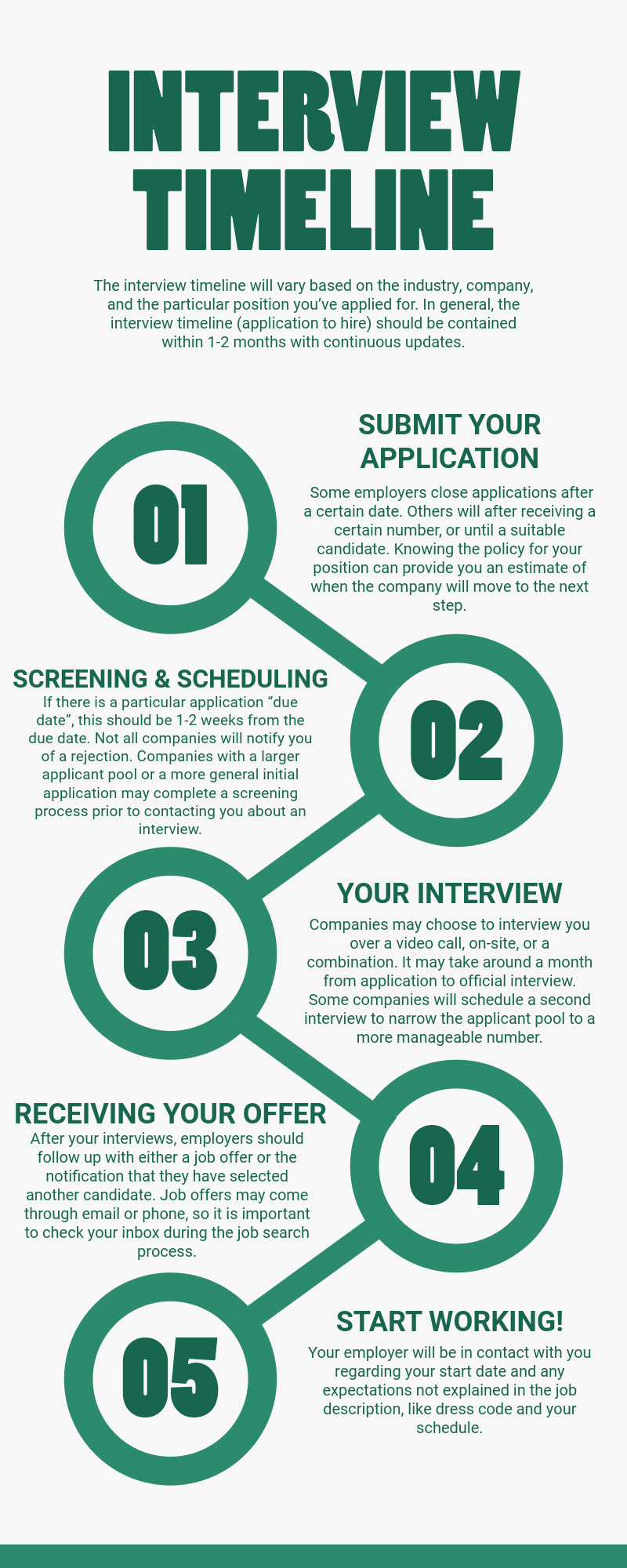
You will notice that employers often ask job candidates similar questions. Knowing these questions, and taking time to prepare responses before an interview, can help you stand out as a suitable candidate. Additionally, it is just as important to always come to a job interview with questions to ask the interviewers. Doing so shows a commitment and genuine interest in the position. Prepare some questions ahead of time; oftentimes, you will come up with new questions during the interview. The best questions are specific to the role and/or content covered in the interview. Wait to discuss salary and benefits until after you receive a job offer, if you are able to do so. Numerous resources exist online with interview questions. The WCU Career Center offers mock interviews so you can practice your responses.
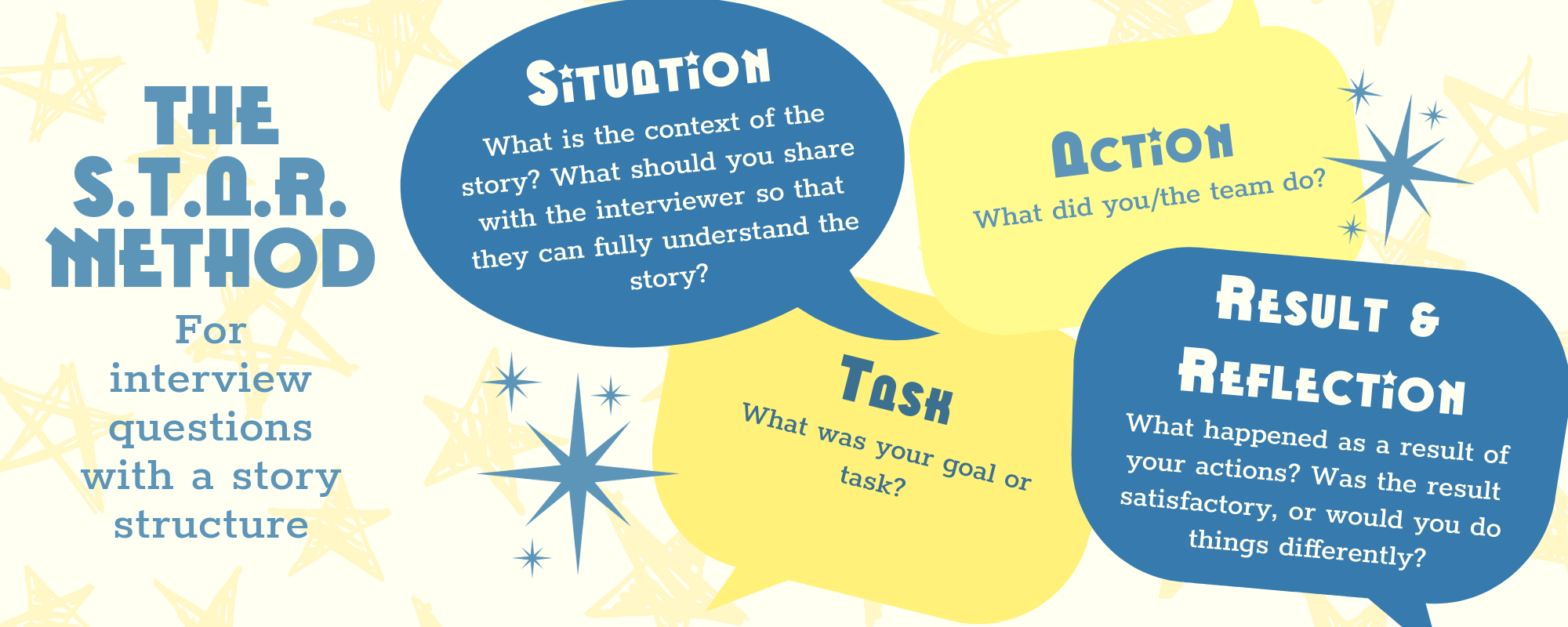
The STAR Method
Use the STAR method to improve your responses to story-based interview questions, like "Tell me about a time you faced a challenge at work".
Research Your Employer: Understanding the Internship Company
Understanding your internship employer will help you perform more confidently and
effectively during the interview. Start with the company’s official website to understand
its mission, values, products/services, and organizational structure. Go beyond the
homepage to review sections such as “About,” “Careers,” press releases, and leadership
profiles to gain deeper insight into company culture and priorities. This preparation
will enable you to clearly articulate how your values, strengths, and career goals
align with the organization.
For public companies, analyze financial and strategic information through SEC filings (e.g., 10-K) and
annual reports to understand performance trends, growth drivers, and key risks. Stay
current by searching the company in major business news outlets (e.g., national newspapers
in U.S. Major Dailies) to identify recent developments, deals, or challenges. Understanding recent news
enables you to demonstrate awareness of the company’s current position and strategy,
while also helping you explain how the role you are applying for contributes to its
goals and priorities. For private companies, gather intelligence through credible online sources such as news articles, industry
outlets, and company announcements.
Leverage professional platforms:
- Use LinkedIn to explore profiles of employees in a similar role, their career paths, and organizational structure, and to identify alumni connections.
- Use Glassdoor and similar platforms to review employee experiences, company culture, and salary insights (while recognizing potential bias).
Finally, network strategically. Reach out to alumni, current employees, or personal connections to gain insider perspectives on the company and specific roles. These conversations often provide insights that cannot be found online and help you better assess fit and expectations.
Research the Industry: Understanding the Internship Industry News and Trends
Developing a strong understanding of the industry in which your internship employer
operates will help you stand out as a well-informed and thoughtful candidate. Start
by identifying the industry’s scope, market segments, and major players and competitors
to understand how the company fits within the broader market.
Research current industry trends, opportunities, and challenges, including technological
changes, economic factors, and evolving customer needs. This context allows you to
speak more insightfully about the company’s direction, its competitive environment,
and its differentiators within the industry. Understanding what sets the companies
apart will help you better connect the industry knowledge to the role you are pursuing.
Be prepared to explain how the position contributes to the company’s success and how
your skills align with industry demands. Demonstrating this level of awareness shows
your initiative, strategic thinking, and genuine interest in the job opportunity.
Leverage professional tools and platforms:
- Use IBISWorld Industry Research to understand the industry trends and market demand, and key success factors in the industry. Use the call prep questions to inspire your interview preparation and ask important questions.
- Use the First Research Industry Profile in Mergent Archives to understand the industry trends and challenges, and there are also call prep questions that you can use to inspire your interview preparation and ask important questions.
- Use the national leading newspapers in the US Major Dailies; follow the trade association website or industry-specific publications to find current trends and news in the industry.
When you understand the field, you can ask more thoughtful questions, engage in meaningful conversations with professionals, build stronger connections during the interview, and ultimately increase your chances of success.
From Internship to Job Offer
Resources
Turning an Internship into a Job (2016) [Course | 54 min]
This LinkedIn Learning course guides you through the process of considering an internship,
finding opportunities, increasing your value, and turning an internship into a full-time
job opportunity.
Turning an Internship into a Job (2020) [Course | 30 min]
This LinkedIn Learning course guides you through the process of finding the right
internship, landing the internship, making yourself irreplaceable, and using your
internship to get a full-time job offer.
Listen to Others — From Internship to a Job Offer:
During Your Internship
While it’s partly your employer’s responsibility to make your internship a valuable experience, there are also plenty of opportunities to deepen your learning on your own terms. There are many ways you can gain a more comprehensive understanding of your career during your internship. Make a copy of this spreadsheet to track what tasks you've completed.
- Get to know your coworkers. Ask them about their educational and professional experience, as well as what a day looks like in their position.
- Ask your supervisor if you can shadow in a different department for all or part of a day.
- If you are interested in sitting in on a particular meeting or working on a particular project, ask your supervisor how you can be involved.
- Confer with the hiring manager/head of HR for insight into your interview and resume. Even though you were hired for the position, constructive criticism and feedback is always valuable for future opportunities.
- Explore ways you can be involved with the company after your internship ends.
- Connect with other interns in your company in similar positions.
- Reflect on how your internship compares with other jobs you’ve had. Think about elements such as job duties, company culture, and opportunities for advancement. What did you like and dislike about each job opportunity? How can you apply this to your job search after graduation?