
Initiatives


Curriculum and Research & Creative Activity
Faculty at West Chester University have long worked to bring sustainability into WCU's curriculum. This work includes academic programs, Faculty Brandywine Workshops, support for research and scholarship opportunities, and Office of Sustainability sponsorship for out of the classroom learning like weekly Sustainability Research and Practice Seminars, lectures, and campus tours.
Curriculum
The Sustainability Council’s Teaching, Learning, and Curriculum committee’s goal is to ensure that WCU students understand the mechanisms of our unsustainable society, work to mitigate their unequal effects, and plan for resilience and renewal.
The committee leads campus efforts to engage faculty and to equip students with the tools, abilities, and belief in their own agency to solve interconnected environmental, economic, and social challenges. The committee promotes and strengthens classroom-based, extracurricular, experiential, and research opportunities that build communities via collaborative, transdisciplinary problem-solving projects. We view the full campus as a pedagogical project in which every structure, event, and process educates the campus community on the need to strive towards a sustainable future.
Projects and Programs Include:
- Brandywine Project – workshops to help faculty incorporate sustainability pedagogy and projects into their classes, as well as to help administrators understand the need to incorporate sustainability into all levels and positions on campus; the Office of Sustainability also hosts Brandywine Project sessions for students and staff.
- Interdisciplinary Sustainability Minor in Sustainability and Resilience – the original broad minor that complements any major, housed in the Interdisciplinary Studies Department.
- Applied Community and Environmental Sustainability (ACES) Minor – focused on the practical applications of sustainability principles to local, regional and global communities and environments.
- Sustainability & Social Justice Leadership Living-Learning Community – a residence-hall based program for 1st/2nd-year students
- Association for the Advancement of Sustainability in Higher Education Center for Sustainability Across the Curriculum – WCU recognized by an international organization as a leader in sustainability education.
We encourage faculty to join our educational mission by taking part in committee activities, by incorporating, foregrounding, and articulating to students the ways in which your classes advance sustainability, and by adopting the WCU sustainability syllabus statement.
WCU Sustainability Syllabus Statement
At West Chester University, we promote the stewardship of an Earth on which life flourishes into a future of increasing prosperity and opportunity, without reducing the capacity of the environment to provide for future generations of humans and other life. Sustainability requires an understanding of the interconnected relationship of environmental, societal, and economic issues and resources at both the local and global levels. West Chester University graduates will be prepared to transform their understanding of those connections into a life-long commitment to environmental sustainability and responsible local and global citizenship.
Research and Creative Activities
- The Campus Sustainability Research and Creative Activities Grant Program provides grants to faculty and student researchers to further sustainability scholarship on campus. See documentation of past grant projects on Digital Commons.
- Two scholarships are available for students interested in sustainability. The Odell-Chisholm Scholarship focuses on students working toward a career in renewable energy, and the Mustalish Scholarship focuses on students passionate about environmental sustainability.
- The weekly Sustainability Research and Practice Seminar shares sustainability-related scholarships and projects from across campus and the West Chester Community. Co-sponsored by the Office of Sustainability, the Office of Research and Sponsored Programs, and the Sustainability Council's Scholarly and Creative Activities Committee, the series shares the work of faculty, staff, students, and community members.
Sustainable Food Systems
University food and dining services can have a significant impact on carbon emissions, the environment, human health, labor and animal welfare. Through the creation, promotion and implementation of sustainable and responsible food procurement, energy and water conservation, waste stream management, and education, West Chester University food service can actively support the university’s sustainability efforts through the reduction of greenhouse gas emissions associated with current food procurement practices.
Get Involved
There are a number of ways to help contribute to a more sustainable food system on WCU's campus! Explore these resources for more information.
- Join the Sustainability Council's Sustainable Food Systems Committee
- Join the Food Systems Management Club
- Join the Free Food GroupMe to be notified when there is free food leftover from an event on campus. Event planners, please join and share your leftovers!
- Visit the Resource Pantry in Commonwealth Hall. The pantry is open to all students with no proof of need required. You can also work or volunteer with the pantry.
- The Campus Gardens produce fresh food that is donated to the Resource Pantry and the West Chester Food Cupboard. Work or volunteer in the gardens to help make an impact.
WCU Dining Services
WCU contracts with Aramark for dining on campus. Aramark has a number of sustainability initiatives they follow on campus.
- Aramark supports local food suppliers like Kegel's Produce in Lancaster, PA
- The Commons Dining Hall features Cool Foods in 20% of their menu
- Sustainable Fish Friday menus available in the Commons Dining Hall
- Follow WCU Dining on Instagram to stay up to date on the latest initiatives
Eat a Plant, Save the Planet!
Partner with the Eat a Plant, Save the Planet campus-wide health promotion! Visit the webpage for more information on plant-based eating including cooking demos, a digital cookbook, and an interactive story map exploring plant-based dining options on and around campus.
Purchasing
Considering the environmental impact of your purchases is an important way to make a difference. WCU's Green Office Program has tips to help you make more sustainable purchasing choices.
More sustainable purchasing practices will help:
- Reduce pollution and conserve resources, including water and energy.
- Improve the university’s environmental footprint on our local community, as well as the global community.
- Reduce costs by optimizing the supply chain, avoiding waste and conserving resources.
- Reduce the amount of toxic substances disposed or consumed.
- Lessen the impact to public health.
Zero Waste
West Chester University has an on-going commitment to REDUCE first and foremost (don’t use so much stuff!), REUSE (don’t buy new stuff!), and RECYCLE (when you can’t REDUCE or REUSE stuff).
REDUCE
Waste prevention, or "source reduction," means consuming and throwing away less. It includes:
- purchasing durable, long-lasting goods
- seeking products and packaging that are as free of toxics as possible
- redesigning products to use less raw material in production, have a longer life, or be used again after its original use.
Source reduction actually prevents the generation of waste in the first place, so it is the most preferred method of waste management and goes a long way toward protecting the environment.
There are a number of actions that you can implement whether in your office at home or at work to further sustainability goals:
- When you need to print, print double-sided. All computer lab and library printers have this option on campus.
- Save and re-use scrap paper. If your academic building, computer lab, apartment, or residence hall doesn't have a place to collect scrap paper for re-use, create one!
- Purchase paper and other materials made with recycled content and certified by the Forest Stewardship Council (FSC).
- Turn off electronics and lights when not in use.
- Educate yourself on expiration dates and proper food storage so you're not wasting money and food by throwing out perfectly good food. Food waste is a huge problem and the number one source of methane emissions in landfills! Try the free FoodKeeper app by the US Department of Agriculture.
- If you drive a car, properly maintain your vehicle so you get the best gas mileage and performance possible. See the Fuel Economy site for tips.
REUSE
Reusing items - by repairing them, donating them to charity and community groups, or selling them - also reduces waste. Reusing products, when possible, is even better than recycling because the item does not need to be reprocessed before it can be used again. Each year West Chester University sells hundreds of surplus items on an auction website that are reused by the buyers. Thus, these items get a second life rather than being discarded in a landfill.
Ways to Reuse
- Using durable coffee mugs.
- Using cloth napkins or towels.
- Refilling bottles.
- Donating old magazines or surplus equipment.
- Reusing boxes.
- Turning empty jars into containers for leftover food.
- Purchasing refillable pens and pencils.
- Participating in a paint collection and reuse program.
RECYCLE
When you can't reduce or reuse something, then it's time to recycle it. While recycling is important, remember that not all materials can be recycled and the natural resources (e.g., land, water, clean air) that went into creating products are not recyclable. So reduce and reuse first! Then when you can't do that, recycle.
When we buy recycled products, we create an economic incentive for recyclable materials to be collected, manufactured, and marketed as new products. Buying recycled has both economic and environmental benefits. Purchasing products made from or packaged in recycled materials saves resources for future generations.
WCU has single-stream ("all-in-one") recycling, which means that all recycling bins on campus are suitable for clean paper, cardboard, glass, plastic, aluminum, metal cans, and now even flexible plastic packaging like chip bags. Non-recyclable items, such as food waste, should be disposed of in waste containers. If you're not sure something is ok for the recycling bin, check out the WCU Recycling FAQ below.
- WCU Facilities Recycling FAQ
- WCU Facilities Policy on Recycling
- For more information on recycling, see the EPA's website on recycling.
- To learn how to recycle other materials not suitable for the campus "all-in-one" blue bins (e.g., hazardous waste items like electronics and batteries), see the Chester County Solid Waste Authority's website.
WCU is also working to reduce E-Waste, both personal and University-owned. You can recycle University-owned electronics through Information Services and Technology. Visit ServiceNow to request a pickup or drop off.
Personal electronics can now be recycled through PAR-Recycle Works by dropping off items in bins in Sykes Student Union and the Francis Harvey Green Library. Refer to our flyer for a list of acceptable items and more information.
Transportation
As of 2010, approximately 25% of WCUs greenhouse gas emissions were associated with student, faculty, and staff commuting. The following initiatives detail our efforts to help curtail these emissions. They have the added benefit of reducing congestion and parking difficulties on campus.
Exton Shuttle
One of the highlights of the Sustainability Advisory Council Transportation Committee's work, begun in 2012, is the Exton Train Station Shuttle Bus. This bus, funded through the WCU President's Office via the External Affairs Division and operated by our Facilities Division, runs between West Chester and the Exton Train Station and connects to the morning and the evening trains. Beginning in Fall 2016, the university has partnered with Chester County, adding two stops to the morning and afternoon commute to accommodate county riders: the West Chester Transit Center and the Chester County Government Services Building. Read more information on the Exton Shuttle and bus service information to and from campus and between WCU locations.
Rideshare/carpool parking spots
Display two or more valid WCU parking permits to park in these centrally located spaces. There are seventeen spaces in all. Look for them in the following lots:
- Lot A is across Sharpless Street from the Business and Public Management Center
- Lot B is between the Business and Public Management Center and 25 University Avenue
- Lot G is across High St. from Philips Memorial Building
- Lot K is behind Sykes Student Union
- Lot L is to the west of Lot K
- Lot M is between High and Matlack Streets near the Swope Music Building
- Click here for the Campus Map
WCU Bicycle Use Pledge Program
Offered through the Department of Public Safety, sign up to use your bike rather than bringing a car to campus and receive discounts at local bike-related retailers.
Bicycle Fix-It Stations
Fully equipped for repairs, air for tires - located at the South Campus Clubhouse (within the South Campus Apts. complex) and outside University Hall on North Campus.
Motor Pool Initiatives
Compressed natural gas (CNG) refueling centers were installed at WCU in 1998. As of fall 2015, we have 28 fleet vehicles (33%) capable of running on CNG - producing fewer greenhouse gas emissions than gasoline and also fewer air pollutants. WCU also has fleet vehicles that run on biodiesel (B20 = 20% non-fossil fuel based energy source)
Public Transit Ticket and Pass Sales
Public Transit tickets and fares available for purchase on the ground floor of Sykes at the SSI Service Window.
Buildings and Energy
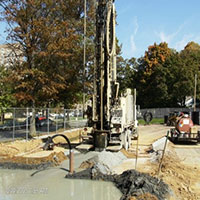
West Chester University has taken significant steps towards energy efficiency. The university has instituted a range of measures that yield significant cost and emissions reductions through its Guaranteed Energy Savings Plan (GSEP) led by Honeywell Building Solutions. It has installed several green roofs and green walls that act to reduce cooling demands in the summer. There are currently three Green Buildings on campus that incorporate numerous features and meet or aspire to LEED (Leadership in Energy and Environmental Design) certification, with a fourth under construction: 25 University Avenue, the Student Recreation Center,the Swope music building, and the new College of Business & Public Affairs building (BPAC). The Swope music building is Silver LEED certified and the new (BPAC) building will seek Gold LEED certification. Above all, WCU is most proud of its ongoing commitment to Geothermal Energy by building one of the largest district geoexchange systems in the world. Though largely hidden from view, the University's investment in geothermal wells is enabling it to significantly reduce carbon emissions while also reducing energy costs. Thanks to the geothermal initiative, 50% of campus buildings are now heated and cooled using geothermal energy and the university was able to decommission its coal-fired boiler plant in 2014.
For more info, see WCU's Facilities Energy & Sustainability website.
How does WCU's geothermal system work? What buildings are heated and cooled by geothermal energy?
WCU's geothermal system offers a wonderful opportunity to learn about green energy.
The campus geothermal system was proposed in 2007 as a means of updating the coal-fired steam plant and electric chillers on-campus. The system currently involves 12 buildings:
- Library one and two
- 25 University Ave.
- Mitchell Hall
- Recreation Center
- Recitation
- Ruby Jones
- Anderson Hall
- Hollinger Field House
- and the residence halls Allegheny, Commonwealth, and Brandywine.
The President's House, the Bull Center, and the Village Apartments use a system separate from the main geothermal connections. There are approximately 650 wells currently with an anticipated total of 1,400.
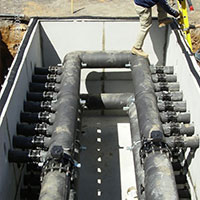
The geothermal system runs by removing excess heat from inside buildings, accumulated by body mass and solar energy, and storing it in below-ground water wells. Due to the high specific heat of water, this heat can be stored as energy so that when heating needs are required on cooler days the automatic, remote computer system will pump the stored heat back into the building. See our Geothermal Poster for more details.
The geothermal system was so efficient that the campus shut down its coal-fired boiler plant in 2014. Fifty percent of the campus is covered by the geothermal system presently, and the other half is heated by high efficiency natural gas boilers. Some more facts:
- The completed system will have a capacity of 16.1 MW including 1,400 152 m (500 ft) deep closed-loop geoexchange wells.
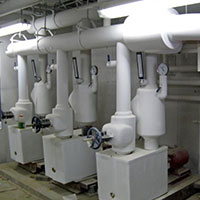
- The majority of buildings are connected to a district system. Thermal exchange fluid (water) is pumped between buildings and a central well field. Hundreds of 10 to 20 kW heat pumps exchange heat between the district fluid and building airspace. Advantages of this approach include:
- Increased peak capacity - buildings require peak heating and cooling during different times of day, reducing the number of required wells (and cost) by 25 percent.
- Increased efficiency - heat can be exchanged between buildings.
- A centralized wellfield was placed at the perimeter of campus, under parking lots and open fields, in order to minimize disruption to the academic area and not impede future building development in the dense central core of campus.
- A redundant system that allows multiple heat pumps, water pumps, wellfield sections, and even buildings to provide heating or cooling in the event of a partial system malfunction.
History of WCU's geothermal initiative
In the summer of 2006, WCU launched a program to replace the eight north campus residence halls (~700,000 ft2) built in the 1960's with new, updated designs that would include geothermal HVAC systems. Since the old residence halls represented more than 35% of the load on the university's more than 50-year-old coal/oil-fired steam heating plant, a study was commissioned to consider cost effective alternatives for the other buildings using this system. In parallel with this initiative, the university had already launched a major energy savings program through a Guaranteed Energy Savings Agreement (GESA) which aimed at overall campus wide energy savings of more than 20%. Therefore, any alternatives to the steam heating system would have to generate savings in addition to those expected from the GESA.
The initial study indicated that it was both feasible and, based on anticipated operational savings exceeding $1M per year, cost effective to convert the other university buildings from steam heating with electric chillers for air conditioning to a geothermal-based HVAC system. Because many of the buildings being considered have HVAC systems that are 25 or more years old, this approach would also provide a path for upgrading obsolete heating systems. A more detailed study was commissioned to develop a conceptual plan addressing each building, as well as to define the size and examine possible locations for the required geothermal well fields to support this approach. By the spring of 2007 a conceptual plan had been produced that answered these questions and showed a very clear beneficial return on the investment required, with expected savings of ~40% for heating and ~20% for cooling. A program to convert more than 25 North Campus buildings over a period of 10-13 years was launched. Among the long term benefits of this program was the expectation that the university could shutdown its central heating plant, eliminating all coal (7000 tons per year) and most fuel oil (200,000 gallons per year) burned on campus, and reducing its emissions by 85 tons of SOx, 54 tons of NOx, and 44 tons of particulate matter that were being emitted from the heating plant every year.
In the spring of 2007, the planned renovation of a 53,000 ft2 academic building at 25 University Avenue (formerly Swope Hall) was altered to include converting its HVAC to geothermal and, with this energy initiative as its basis, a $242K Pennsylvania Energy Harvest Grant was obtained and applied to offset most of the cost to install the 35 geothermal wells needed to support this system. The ongoing GESA was modified to apply the funds planned for HVAC improvements to the 140,000 square foot Francis Harvey Green Library to converting its HVAC system to geothermal (water source heat pumps) which would be supplied from a well field to be installed later (temporary provisions are included to compensate for the lack of the geothermal wells until they are available). Planned GESA HVAC improvements in Ruby Jones Hall (21,000 ft2) were also changed to convert the building to geothermal HVAC.
To become involved or learn more about research initiatives involving our geothermal exchange system, please contact Dr. Martin Helmke in the Earth & Space Sciences Department, the chair of the Geothermal Working Group on campus.
Trees and Green Spaces
West Chester University is proud to present many sustainable landscaping alternatives on its campus. These initiatives assist the university with its efforts to reduce its use of traditional landscaping practices such as monoculture lawns, non-native plantings, and the use of chemical herbicides and pesticides. Sustainable landscaping also improves water quality and helps to reduce stormwater runoff.
Rain Gardens
Rain gardens on campus help to effectively reduce stormwater runoff and improve water quality. They can be found at the Poetry Center, Outdoor Classroom & Demonstration Garden by the Science Complex, and Human Resources on Carter Drive.
Outdoor Classroom and Demonstration Garden
Dedicated on April 21st, 2009 the learning garden was designed to engage students, faculty and guests in appreciating the native plant and wildlife of Chester County. Plantings such as red chokeberry, joe pye weed, hyssop, berry bushes, and many others draw in songbirds (and squirrels) to the feeder watch site. Art classes use the area for inspiration and environmental studies students are often there as well.
The outdoor classroom was expanded to include a vegetable and herb garden managed by faculty, staff, student interns, and volunteers. Read about How to Create Your Own Native Garden in an essay written by Erika Szonntag, Biology Student at WCU.
South Campus Community Garden
Established in February 2015 by the South Campus Apartments, the community garden is an effort to encourage students to learn where food comes from and how it is grown to better understand the importance of nutrition and health, as well as exploring composting, bee-keeping and cultivation techniques. The garden was built on an under-utilized lawn area and is open to faculty, staff, students, and the community.
Swope Water Retention Basin
This is an on-going project led by several student groups and sponsored by the Provost’s Year of Water Grant. Students are creating a rain garden and beginning the naturalization process of the lawn area to reduce water runoff into the community water system.
Merion Science Center & Green Library
These two buildings are host to two green roofs that act to reduce water runoff, beautify campus, and reduce cooling costs.
Robert B. Gordon Natural Area for Environmental Studies
This nature preserve encompasses 73 acres of land belonging to the campus. The mission is to preserve a natural ecosystem and to minimize human disturbance so as to allow the habitat to serve as a laboratory for environmental studies. The legacy of the Gordon Area began with two students, Bradley Gottfried and Dave Fluri, convincing the Board of Trustees to establish a natural area. The preserve was set aside in 1971 and commemorated to a science professor of 25 years, Robert Gordon. In 2012, President Weinstein set aside 12 more acres in 2013.
The area is managed by a Stewardship Manager. It was designated a Wild Plant Sanctuary by PA DCNR and received a research grant from USDA Forest Service. Research on natural succession, Emerald Ash Borer, carbon storage and sequestration, and invasive plant management are some of the many ongoing studies. The natural area includes foot trails for tours and community exploration.
Tree Campus USA and ArbNet Arboretum
The trees on campus provide numerous environmental and aesthetic benefits. In recognition of the diversity of trees on campus and the university’s efforts to maintain and enhance this resource, the WCU campus is a Level II ArbNet certified Arboretum and has been recognized as a Tree Campus USA for four years running. Faculty and students in Geography & Planning and Biology work cooperatively with Grounds to maintain a geodatabase of all trees on north and south campus. This geodatabase is used to help Grounds manage this invaluable resource and provides teaching and research opportunities for faculty and students.


Water
Rain Barrels
Student built and managed rain barrels have been installed on campus. Rain barrels help reduce rooftop run off and conserve rain to water campus gardens during dry periods. Learn more by visiting the rain barrels in the Outdoor Classroom and Demonstration Garden next to the Science Complex Link on north campus.
Green Roofs and Green Walls
Green roofs have been installed above the Francis Harvey Green Library link and on Merion Hall. Green roofs conserve water and reduce run off by using otherwise unused roof top space to cultivate drought tolerant species of plants. Plans are underway to bring additional green roofs to WCU in the future. Green walls serve a similar function to green roofs. Currently, the most developed green wall on campus is in the Outdoor Classroom & Demonstration Garden on north campus next to the Science Complex, however a number of green wall trellises have been installed and are in various stages of development. Look for them at the Student Recreation Center and other newer buildings.
Storm Water Management
The WCU Microbiology Club has organized with various faculty and student volunteers to revitalize the rain water basin outside of the Swope Music Building. This has included the construction of swales to divert parking lot run off to decrease water pollution. Corresponding studies into the microbial breakdown of pollutants in the basin have been initiated.
Water Research and Stream Restoration
Plum Run is a small tributary of Brandywine Creek that meanders for approximately three miles towards the southwest from its underground sources on the campus of West Chester University to its confluence with Brandywine Creek just downstream from the Brandywine Picnic Park. Its east branch flows through South Campus and the Robert B. Gordon Natural Area for Environmental Studies. From 2009-2014, Plum Run underwent restoration along several impaired portions of the stream as part of a Watershed Renaissance Initiative awarded by the PA Department of Environmental Protection to the Chester County Conservation District and the Brandywine Valley Association Red Streams Blue program. Plum Run is the focus of many research and service opportunities for West Chester University faculty and students, including in the Departments of Environmental Health, Biology, Geology & Astronomy, and Geography & Planning. For example, water researchers in Environmental Health have been actively monitoring the health of local stream waters within the Gordon Natural Area, including Plum Run. For more info on Plum Run, see The Flow of History along Plum Run. Additional water-related research activities include research projects in the Biology Department on developing bio-electrochemical technologies to convert organic material in wastewater into useful bioenergy, and the ecological impact of artificial ponds.
Water Conservation
University Student Housing (USH) has installed water bottle filling stations around campus to help reduce litter and plastic waste while further conserving water.